Monday, 10 December 2012

André da Loba and Stephen Byram

 Continuing on from New York, the morning after we arrived we went to Brooklyn to visit an art studio that used to be an invisible dog leash factory (amusingly). Inside we were kindly greeted by the illustrator André da Loba who allowed us to wander the building.

 The building was shared by various artists including a favourite of the college's, Oliver Jeffers, who also came out of his studio to say hello. The environment in which these artists worked had such a calm and relaxed atmosphere. André said that working around others in the same practice provides him with influence for his work, which I highly think upon myself. Looking around André's studio, his style of work consisted mainly of  brightly painted 3D animals and objects. This I believe he mentioned is influenced from his Portuguese origin.

 He then demonstrated his work in the top studio through storytelling. Each of the handmade objects he unveiled from his suitcase each had its own little life morals. They were stories relating to normal day-to-day things, but with a charming twist which he demonstrated through the wit of his work. This was certainly and enjoyable and very inspiring visit.




 We left the studio and took the subway back to Manhattan for something to eat. After, we got a coach to New Jersey to visit a designer named Stephen Byram. He allowed us into his home and was very hospitable even offering us all drinks and sweets!

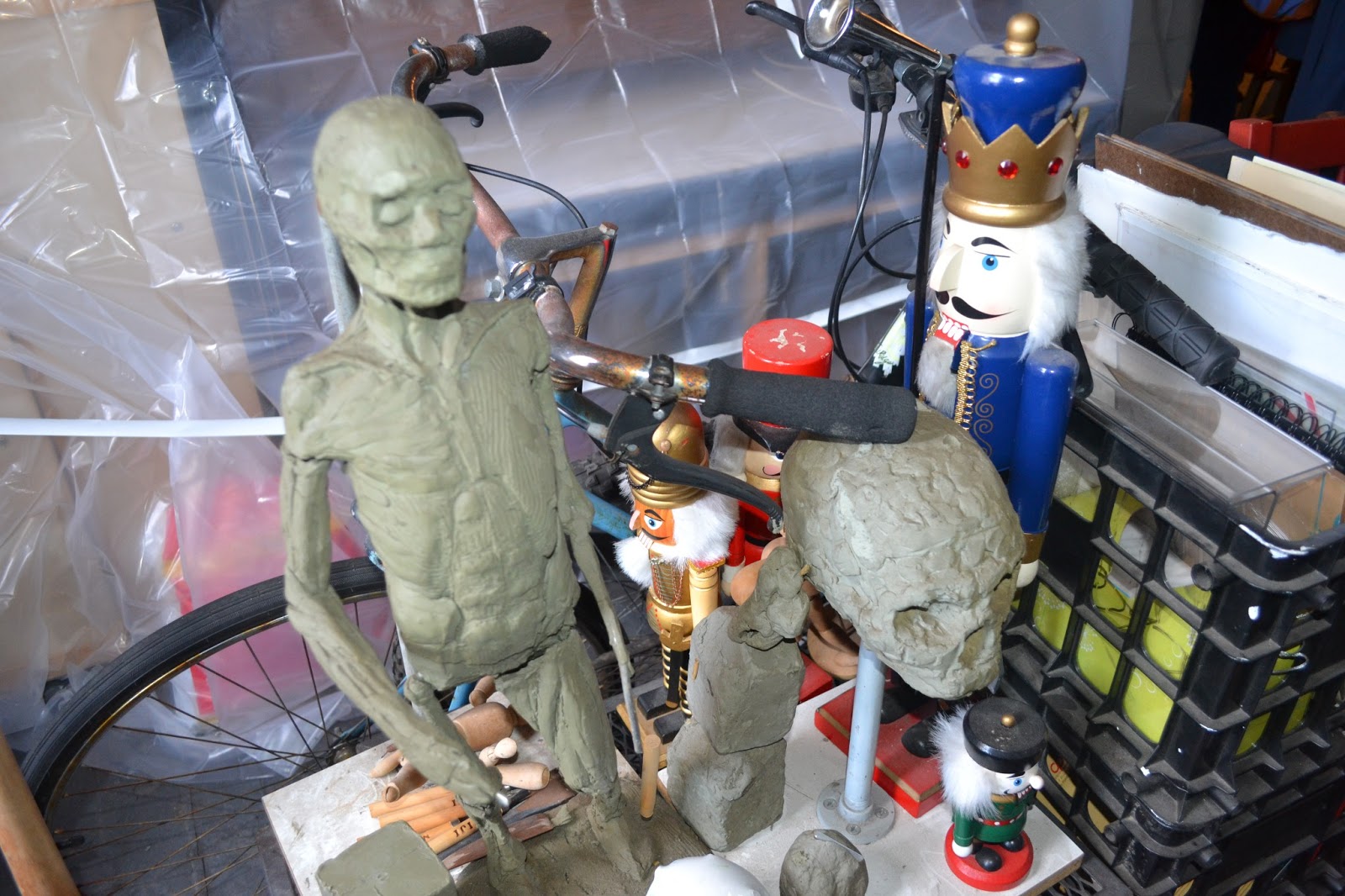
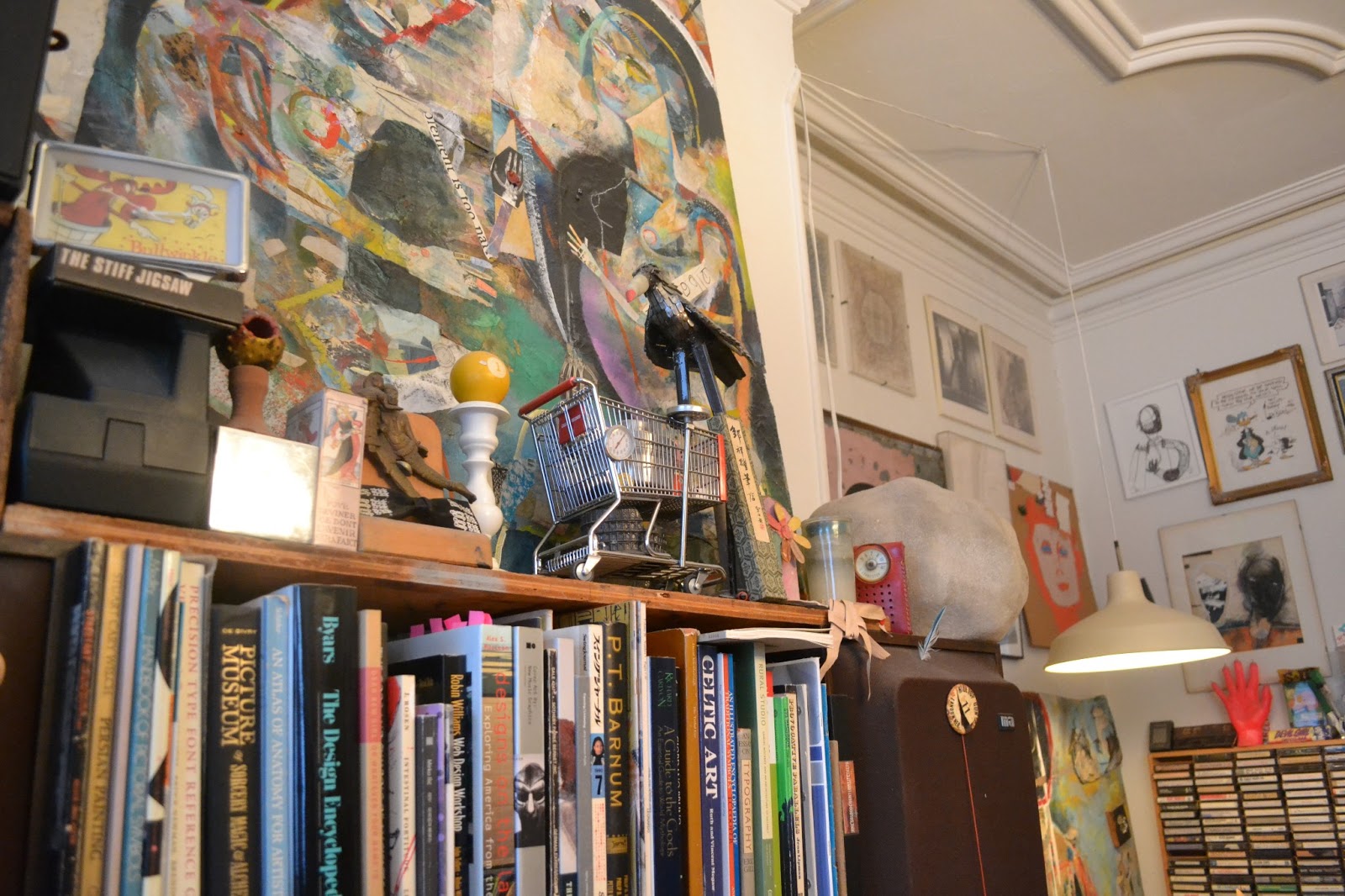
 He had displayed all of his work around the house which varied from 3D sculpture, album covers and canvas designs. It was evident also that he was a fine artist. He showed us his studio downstairs which was full of 3D sculptures he was currently still crafting.

 I asked him about two album covers (Reign in Blood by Slayer and Time's Up by Living Colour) that were displayed on his child's bed that I recognized and he happily expressed to me some background knowledge about them.



The Big One


 "City of prose and fantasy, of capitalist automatism, its streets a triumph of cubism, its moral philosophy that of the dollar. New York impressed me tremendously because, more than any other city, it is the fullest expression of our modern age." - Leon Trotsky, 1930

  On 5th November 2012, myself and the other students, along with our tutors, visited the most famous city in the world: New York! It was my first time ever in the states, so it was going to be a special experience. Having previously visited Krakow in Poland the previous year, it was now New York's turn to inspire us.

 Upon entering Manhattan on the coach, my eyes were unable to close due to the shear scale of the place. The skyscrapers looked as though they were modern day cathedrals. Just seeing how many there were, all congested into one space too was an odd concept. The place confirmed what my preconceptions of America were. Everything in comparison to the UK just seemed so much bigger: the cars, the buildings, the food. I found it expressed a certain arrogance, but found it also to be quite charming.

 We stayed in New York for five days and we visited art galleries, exhibitions, city attractions and even people's houses! We travelled right across New York from Times Square to Soho to Brooklyn and even to New Jersey. I shall explain further in my next posts what we got up to.


Sunday, 18 November 2012

"We're off to see the Jellyfox."


http://media.tumblr.com/tumblr_lyw7gsUMp41qhorwb.gif
 This Halloween, me and two of my friends created masks each based on characters from Noel Fielding's Luxury Comedy TV show. There are four characters in the sketch and they all have Fielding's eyes and mouth distorted into different facial characteristics. The lowest image displays the four, from left to right: Spoonsnake, Li'l Chrissy, Claw and McCoy. Li'l Chrissy tells of what they are seeking, which is 'the Jellyfox' who will resolve there problems. It's very surreal humour.

 The characters are made up from the collaging method and are painted in four bright colours, so this appealed to us a lot being art students. I chose the Spoonsnake, Natalie chose Li'l Chrissy and Tom chose McCoy. We made the masks in the same method, by painting bits of newspaper in different shades and sticking them all over a cardboard cut-out of the character's face. We added texture as well to heighten the eyebrows and nose, simply by placing more cut-out cardboard onto the mask.

Thursday, 15 November 2012

David Shrigley


 About two weeks ago, me and two of my best friends visited the Cornerhouse in Manchester to see the David Shrigley exhibition: HOW ARE YOU FEELING? It was a brilliant experience and it certainly made an impression on me.

 The galleries were divided upon three floors. The first consisted of 3D and interactive elements of his work. He'd placed a black gong in the middle of the room with the appropriately placed word 'GONG' in the centre. There was also a white board where you could write how you felt.

 The second floor consisted of his illustrations. There was a countless amount and they were all highly amusing. They were literally drawings that had come straight out of his head. The reoccurring message throughout all these drawings was that they deliberately had no context to them whatsoever. They are a protest against the pretentious surroundings of art.

 The final floor was a room in which people were allowed to participate in life drawing. Shrigley had placed a strange looking model of a male figure in the centre of the room which was in full nude and once every five minutes or so, would urinate into a bucket. Me and my friends sat around and made a few of our own interpretations. At the other side of the room there was a scene set up in which people were allowed to re-enact. There was a script to follow and it evoked the message that all art is priceless.

Wednesday, 14 November 2012

Varoom: Paper Tigers Article Summary

 Over the course of several weeks, we looked over four pieces of texts to do with art and it's cultural context. We were to analyse the texts and choose one to discuss through a presentation. I chose the last one which I explain about in the summary below:

 In this presentation I will be discussing Peter Lyles’ article about how Le Gun (an underground illustration zine) is rebelling against the commercial influence on illustrative production.

 The style of writing in which this article is presented is mainly informative and requires only basic knowledge within illustrative culture; thus making it non-academic also.
 This leads onto the next point about who the article is intended for. The article covers basic knowledge on illustration, so the most obvious of candidates would be illustrators. The next would be students studying the subject due to the article’s informative nature and that it involves research aspects - such as the quotes and imagery.
 The main argument being discussed within the article is that Le Gun feels lots of contemporary illustrators are losing the purity of their work due to the commercial rewards they wish to possess. Whilst Le Gun stays true to their work and do it purely out of enthusiasm, other illustrators give into the commercial pollution.
 Commercial pollution comes as a theme throughout the article also. It’s called ‘selling out’ and the phrase has been used by youth culture many times to describe, for example, a band becoming popular and thus giving them the chance to make better produced records. The fact that Le Gun encourages illustrators to use digital technology only as a tool is also a theme.
 The underpinning theory would be that this article expresses the sense of post-modernism in the fact that fully, computer-aided illustrator’s work is becoming far more generic. With the aid of a computer, processes become much quicker and mistakes are easily removable as opposed to something hand-rendered.

 Overall, Lyle points out that technology has come so far now that it is beginning to replace our natural artistic heritage of getting our hands dirty.

Tuesday, 16 October 2012

More Music and Sounds!

http://1.bp.blogspot.com/-cdBk4F4HvzQ/TYCkoWx1JSI/AAAAAAAAAAM/2MzYDG2XJvQ/s1600/thumbnail-KB.jpg
http://media.giantbomb.com/uploads/0/5589/863661-mgs_integral_cover.jpg
http://leviathyn.com/wp-content/uploads/2012/10/ffx1.jpg?9d7bd4
 In the process of creating my animation, I needed to acquire sound effects to sample. I made a few of them myself including a 'splat' noise and the rest I recorded from the internet.

 My main choice of sampling was a instrumental score composed by Quincy Jones, named Ironside. It came to my attention from watching Quentin Tarantino's film, Kill Bill. Tarantino samples the music himself for Kill Bill and uses it for whenever the protagonist sees her next victim. It is some form of alarm sound, which I find appropriate for my animation when the creature sees his rival.
 Another musical score that came to mind was something from the epic video game saga, Final Fantasy. Whenever the player claimed victory in battle, a distinct chant of music would play marking a success. My creature will find something that he very much desires, in which the music will play.

 Lastly, a sound effect from another video game saga, this time known as Metal Gear Solid. Whenever the protagonist was spotted by an enemy, a sudden alert sound would play. My creature will spot his rival, the Cheshire Cat, alongside the alert sound.

Musical Influence


 For my animation, I wanted to add something that would make the process ever more nostalgic. As a child I watched Cartoon Network for hours upon end and I was intrigued by everything it threw at me: the visuals, the camera angles. the humour, the sounds... This cartoon in particular had an instrumental intro which has remained in my head since it aired in the early 90s. I now happen to play both guitar and bass (mainly bass) in my spare time, so it seemed very much appropriate to apply these skills into my own animation.

 With the aid of my dad and his recording equipment, we created a short score together which would play in the intro and finale for the animation. I wanted it to be short and snappy, so we kept it a 30 seconds maximum. I played both the distorted guitar and the high treble bass and we chose a drum beat from a drum machine. We also scored a bluesy bass line which would play in the first scene involving the creature acting 'cool'.